
This Week in 30 Seconds
- AI: demand remains strong; cash conversion and incremental ROIC separate the winners.
- Markets: buy quality in stages, preserve liquidity and build Treasury exposure gradually.
- Singapore property: investigate scarce assets below defensible comparable value.
01 AI: strong demand, diverging returns on capital
Amazon and SK Hynix illustrate two different positions in the AI investment cycle. AWS Q3 revenue grew 39% to US$46bn, while Amazon's trailing 12-month free cash flow was an outflow of US$42.4bn. Expected 2026 capital expenditure was about US$220bn. Strong demand does not automatically translate into shareholder returns.
The source brief records SK Hynix quarterly operating profit above ₩83tn, more than seven times the prior-year level, production commitments extending through 2029 and about US$75bn in shareholder returns. Scarce capacity supports supplier pricing power. CXMT's reported HBM3E yields of roughly 20–30% also show that Chinese competition is progressing; exceptional memory margins should not be extrapolated indefinitely.
My view: Study profitable semiconductor leaders—TSMC, ASML, SK Hynix and Micron—during corrections. Focus on incremental ROIC and free cash flow, rather than revenue growth alone.
Opportunity / risk: Better entry prices can improve returns. Memory pricing, capacity expansion and hyperscaler spending can also reverse. A good business still needs a sensible valuation.
02 Global markets: a sharp sell-off is not a valuation
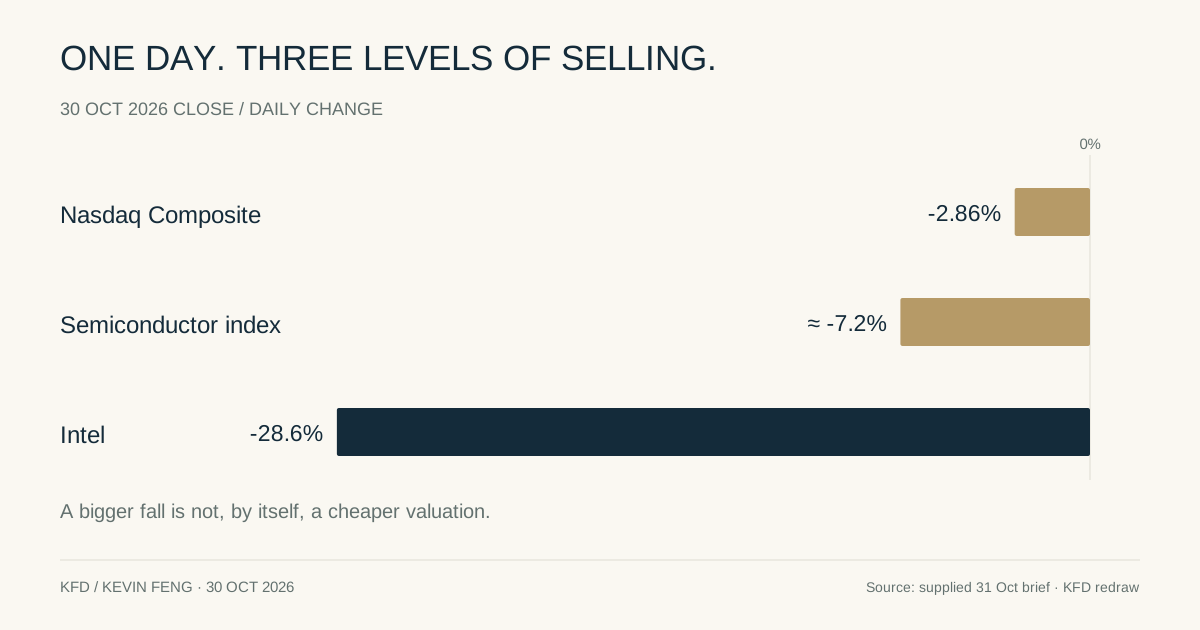
On 30 October, the Nasdaq fell 2.86%, the semiconductor index declined about 7.2%, and Intel lost 28.6%. Selling pressure alongside strong AI adoption points to a repricing of the capital required to fund growth.
| Indicator | 30 October 2026 close |
|---|---|
| S&P 500 | 7,580.07 |
| Nasdaq Composite | 25,437.00 |
| US 10-year Treasury yield | 4.93% |
| Brent crude | US$117.63 |
The Fed held its policy range at 3.75–4.00% on 28 October. Elevated energy prices, persistent inflation and expensive financing remain a difficult combination. Safe-haven buying helped Treasury yields fall, but does not establish that yields have peaked.
My view: Preserve buying power and accumulate resilient, high-ROIC businesses in stages. A price decline becomes interesting when forward earnings have not deteriorated proportionately. Build Treasury exposure gradually, favouring shorter duration for stability and a smaller TLT position for potential upside. Long-duration bonds remain rate-sensitive.
03 Singapore property: new land costs, resale relative value
The 29 October Orchard Boulevard residential tender attracted five bids. A Hong Leong Holdings–TID joint venture led at S$181.86m, or S$1,755 psf ppr—about 8.3% above the second bid. The 99-year site could accommodate approximately 110 homes. URA had not awarded the site at the source brief's research cutoff.
The bid was also about 8.5% above the S$1,617 psf ppr paid for the nearby UpperHouse site in 2024. This supports confidence in a particular location, connectivity and manageable project size; it does not establish a broad CCR upswing.
My view: Screen large-format D9/D10/D11 freehold resale homes and scarce landed property. Compare genuinely similar locations, layouts, holding costs and exit liquidity, rather than treating new-launch prices as a sufficient benchmark.
Opportunity / risk: A 15–20% discount to defensible comparable value warrants investigation, not an automatic buy. High land costs can squeeze development margins; premium launches remain exposed to affordability and resale-liquidity constraints.
04 China & Southeast Asia: cheap needs institutional confidence
The source brief records an approximately 40% year-to-date decline in Indonesian equities and an MSCI warning over emerging-market classification, linked to ownership transparency and trading practices. Proposed reforms address shareholder disclosure, concentrated ownership and minimum free float. Rupiah weakness adds risk for USD-based investors.
Indonesia retains long-term strengths in population, resources, finance and infrastructure. China's industrial expansion also creates Southeast Asian supply-chain opportunities. Economic potential, however, is different from minority-shareholder returns.
My view: Watch financially strong banks and consumer businesses with sustainable ROE, transparent ownership and positive free cash flow. Wait for clearer governance improvements and currency stabilisation before taking a significant position.
Opportunity / risk: Structural discounts can create bargains or value traps. Foreign outflows, currency depreciation and uncertain reform remain material risks.
What I Would Do Now
TSMC / ASML
Accumulate selectively in 3 tranches; check forward earnings and valuation.
Dated context
2026-10-31 · 30 Oct 2026 close: Nasdaq −2.86%, semiconductor index about −7.2%; no individual entry price or valuation multiple specified.SK Hynix / Micron
Buy meaningful pullbacks; monitor memory pricing, new capacity and 2027 earnings.
Dated context
2026-10-31 · 30 Oct 2026 close: Nasdaq −2.86%, semiconductor index about −7.2%; no individual entry price or valuation multiple specified.Quality US equities
Buy selectively: durable free cash flow, high ROIC and conservative leverage.
Dated context
2026-10-31 · 30 Oct 2026 close: Nasdaq −2.86%, semiconductor index about −7.2%; no individual entry price or valuation multiple specified.US Treasuries / TLT
Build gradually: shorter duration for stability, smaller TLT exposure.
Dated context
2026-10-31 · 30 Oct 2026 close: US 10-year yield 4.93%; TLT entry price not specified.Singapore landed / CCR resale
Screen below defensible comparable value; a 15–20% gap requires due diligence.
Dated context
2026-10-31 · 29 Oct 2026 tender: S$1,755 psf ppr; property-specific comparable values required.Indonesia equities
Watch, do not chase; wait for governance progress and currency stabilisation.
Dated context
2026-10-31 · As of the source brief: Indonesia equities down about 40% YTD; no target entry price specified.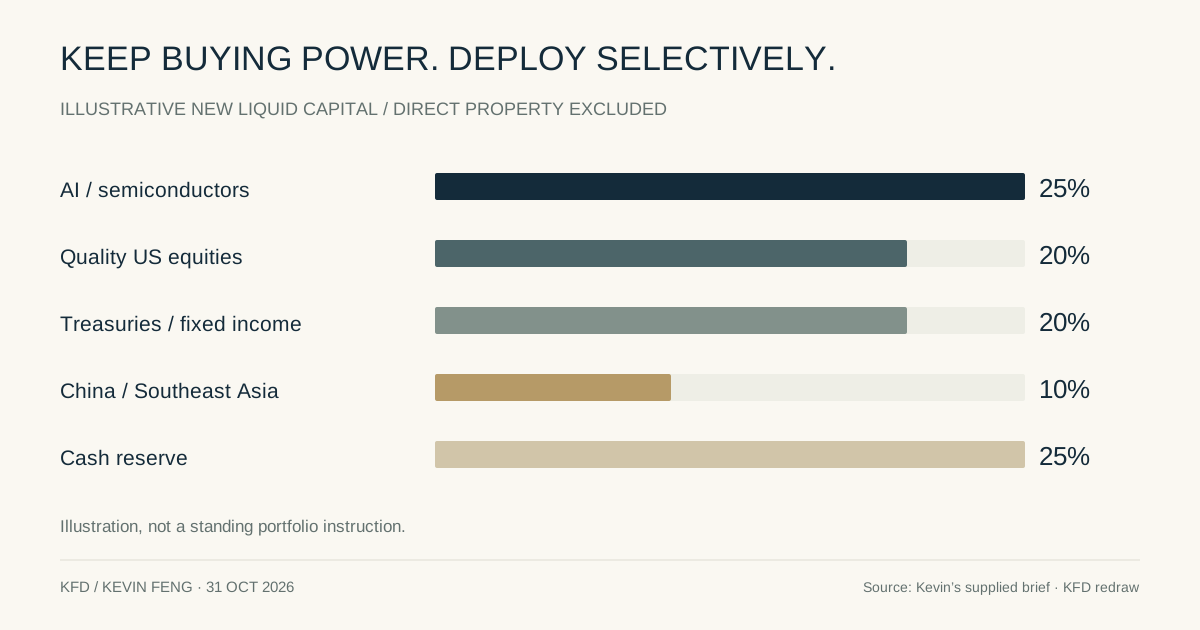
The AI revolution is real, but not every participant will deliver attractive shareholder returns. Certainty first. Capital efficiency second. Valuation always. Next week I would watch US employment and inflation expectations, Apple/AMD/Qualcomm earnings, and Indonesia’s response to MSCI. Resilient forward earnings at lower valuations would make me more constructive; weaker cash conversion would make me more cautious.
Research source
Edited from the English brief supplied and approved by Kevin. Market data is the source brief’s dated snapshot. 31 Oct source brief ↗
Amazon Q3 earnings filing ↗Kevin Feng · Investor, Singapore property + global technology. This article reflects Kevin Feng's personal investment research and views and is provided for general information only. It does not constitute personalised financial, investment, legal or tax advice. Please note that market conditions, prices and valuations may change after the research cut-off date.