Research checked: 29 October 2026. General market education and analysis; all labelled hypothetical examples are not recorded transactions or quotations.
The big question: What kind of housing demand is growing?
A growing population makes an appealing property story: more people should mean more valuable homes. For a household committing several million dollars, that argument needs more work.
Population is the starting point of a demand analysis, not a reason to buy any particular home. Who is arriving? How will they live? What can they afford? How many competing homes will be available in the same area? Skipping those questions can turn a national trend into an unjustified promise about one development.
Market analysis: Break down the 6.21 million
Published on 25 September 2026, the National Population and Talent Division's Population in Brief 2026 reports a total population of approximately 6.21 million in June 2026, up 1.6% from June 2025. Population source
| Group | Approximate population, June 2026 | What the number does not establish |
|---|---|---|
| Citizens | 3.68 million | Every additional citizen will immediately buy a home |
| Permanent residents | 0.55 million | PR households face the same purchase conditions as citizens |
| Non-residents | 1.98 million | Everyone will rent or buy a private condominium |
| Total | 6.21 million | Housing demand will increase in the same proportion |
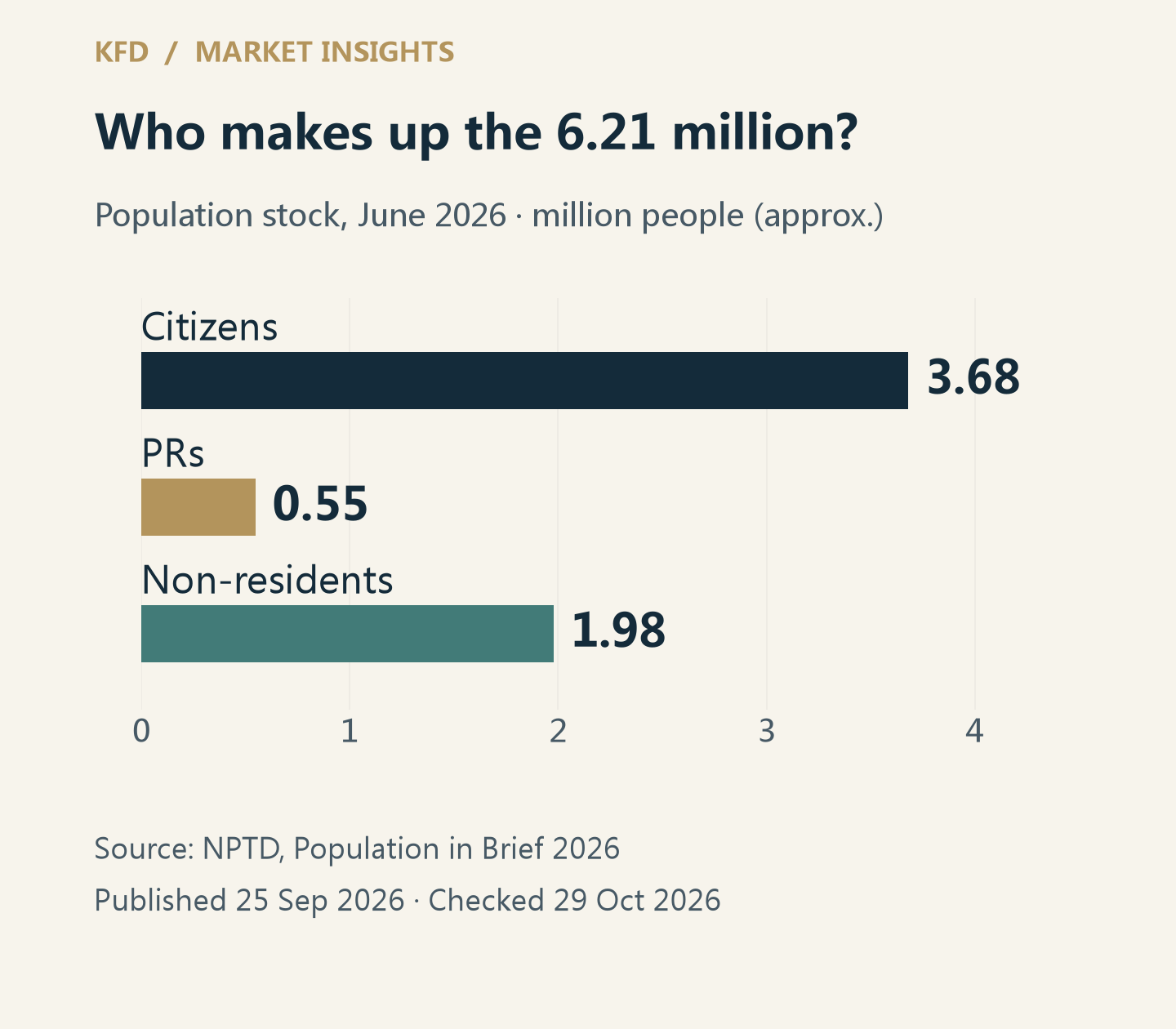
These are population stocks, not the number of new homebuyers in a year. Crucially, the official release identifies non-residents—particularly construction-sector Work Permit holders supporting major developments and housing supply—as the main driver of growth. That composition cannot simply be entered into a model as additional private-home demand. Population source
There is another implication: population growth supporting housing construction can coincide with an increase in future supply. Looking at demand alone leaves half the assessment unfinished.
What the data really means: Four steps from people to homes
First, identify the living arrangement. People working in Singapore may require a whole home for their family, share accommodation, or live under arrangements linked to their employment. Population statistics do not say how many additional tenants a particular condominium will attract. Research the relevant employers, jobs, actual leases and competing homes rather than treating every non-resident as an expatriate executive.
Second, examine household formation. A family having a child does not necessarily require another dwelling. Two adults leaving their parents' homes to establish a household may create demand for an independent home. Households may also delay moving, share accommodation or relocate. People, households and dwellings are different units of measurement.
Third, distinguish eligibility from purchasing power. Residency, existing ownership and finances affect housing choices and tax costs. Under current IRAS guidance, foreigners generally face 60% ABSD on residential purchases, with potential relief for qualifying cases such as specified Free Trade Agreement treatment. It is therefore incorrect to apply one tax conclusion to every non-resident. A residence or work pass is also not the same as property purchase eligibility. IRAS ABSD
Fourth, locate the demand and the supply. National growth does not distribute itself evenly across neighbourhoods. Commuting, total housing costs and project completions influence where demand lands. Compare available rentals, homes for sale and forthcoming completions within the same catchment, rather than relying on population growth alone.
An illustration: 1,000 more people do not mean 1,000 more condos
This is a hypothetical demonstration of the calculation, not an observed population profile or rental forecast.
Suppose 1,000 people are added, with accommodation for 600 already included in existing employment arrangements. If the remaining 400 form new independent living units averaging four people each, that represents 100 dwellings. At two people each, it represents 200. Joining existing households, departures, vacant homes and relocation would further affect the result.
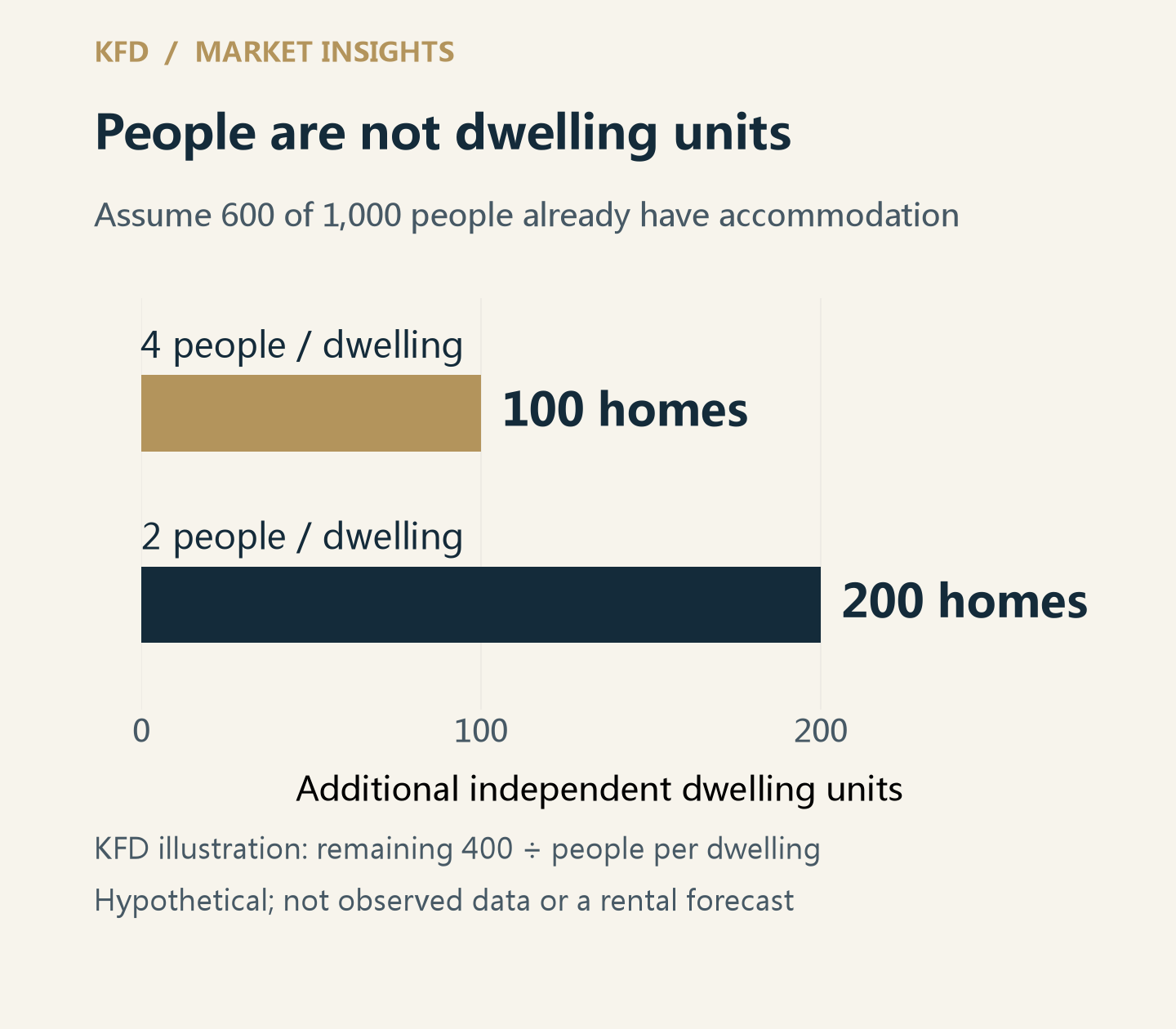
The share forming independent households and the number of people per household can matter as much as the headline population increase. Dividing all 1,000 by a national household average may still apply the wrong assumption to the wrong group. The example tests reasoning; it cannot estimate how many new homes a particular district will absorb.
Do not let a population story obscure the property
URA's full third-quarter release, published on 23 October 2026, reports a 1.4% quarterly increase in the overall private residential price index and a 1.3% increase in the rental index. These are published results for that quarter, not a forecast of 2027 returns. They do not establish that population change alone caused prices to move. URA full Q3 statistics
For investors, the analysis should narrow progressively. National trends establish context; local employment and supply shape competition; the unit's price, layout and achievable rent determine feasibility. A correct view on demand can still produce a disappointing return if the purchase price is too high, vacancy lasts longer, or holding costs are excessive.
For owner-occupiers, population trends help explain the wider setting but do not replace income stability, commuting and everyday needs. The value of a more convenient, suitable home is not fully captured by a national index. Equally, an unaffordable home does not become safe because the macroeconomic story sounds persuasive.
Five questions to take into a property decision
- Am I assessing citizen households, PR households or a particular group of non-resident tenants?
- What verified evidence supports their eligibility, budget and household size?
- Do actual nearby leases support the rent I am assuming?
- Which new and existing homes will compete during my holding period?
- Can my household handle lower rent or a longer vacancy than expected?
Population growth deserves attention. A property purchase still comes down to who will live there, who might buy it, why they would choose this unit, and how much I am paying for that demand.
To connect population trends with a specific location, budget and shortlist, speak with Kevin Feng Division. Clarify the demand and the assumptions before deciding on the next move.
Sources and reference periods
- National Population and Talent Division, Population in Brief 2026, published 25 September 2026. Population stocks: June 2026; growth comparison: June 2025. Annual published data, not a quarterly property forecast. Release
- URA, Q3 2026 real estate statistics, published 23 October 2026. Price/rental changes compare Q3 with Q2. Full quarterly release, not the 1 October price flash estimate. Release
- IRAS, Additional Buyer's Stamp Duty, current guidance checked 29 October 2026. Cited rates apply from 27 April 2023; a separate editorial update date was not established. Buyer profile, joint purchases and relief require case-specific verification. Guidance