
When headlines become unsettling, investors look for certainty. War lifts energy risks, inflation erodes cash, and AI reshapes wealth and employment. Does that automatically make Singapore property a stronger buy?
Singapore’s institutions, location and economic role warrant long-term research. But a country’s appeal cannot replace the investment case for an individual home. A growing economy and rising property prices can coexist with pressure on an owner’s cash flow.
Resilience comes from genuine demand, a sensible entry price and the ability to hold. A macro narrative is where research begins.
01Start with comparable facts
These official observations were checked as at 26 October 2026. Full-year forecasts, quarterly index changes and quarter-end stocks measure different things.
| Indicator | Verified figure | How to interpret it |
|---|---|---|
| 2026 GDP growth forecast | 4.5–5.5% [1] | Government forecast announced on 11 August; not realised full-year growth. |
| 2026 core inflation forecast | 1.5–2.0% [2] | MAS forecast on 14 October; excludes accommodation and private transport. |
| Private home price index | Q3: +1.4% quarter-on-quarter [3] | An aggregate index, not a return for every home. |
| Private home rental index | Q3: +1.3% quarter-on-quarter [3] | Not every landlord’s renewal outcome. |
| Completed private home vacancy | Q3-end: 7.2%, excluding ECs [5] | Up from 6.4% in Q2; local leasing competition still matters. |
| Unsold units with planning approval | Q3-end: 20,300, including ECs [5] | Development pipeline inventory, not completed vacant homes. |
The evidence shows continued aggregate price and rent growth alongside leasing and supply considerations. It does not establish a universal shortage or immunity from price declines.
02One oil shock, two channels
Higher oil prices can increase energy, logistics and some material costs. They may also affect inflation and financing. At the same time, a larger energy bill leaves households and businesses with less purchasing power for other activities.
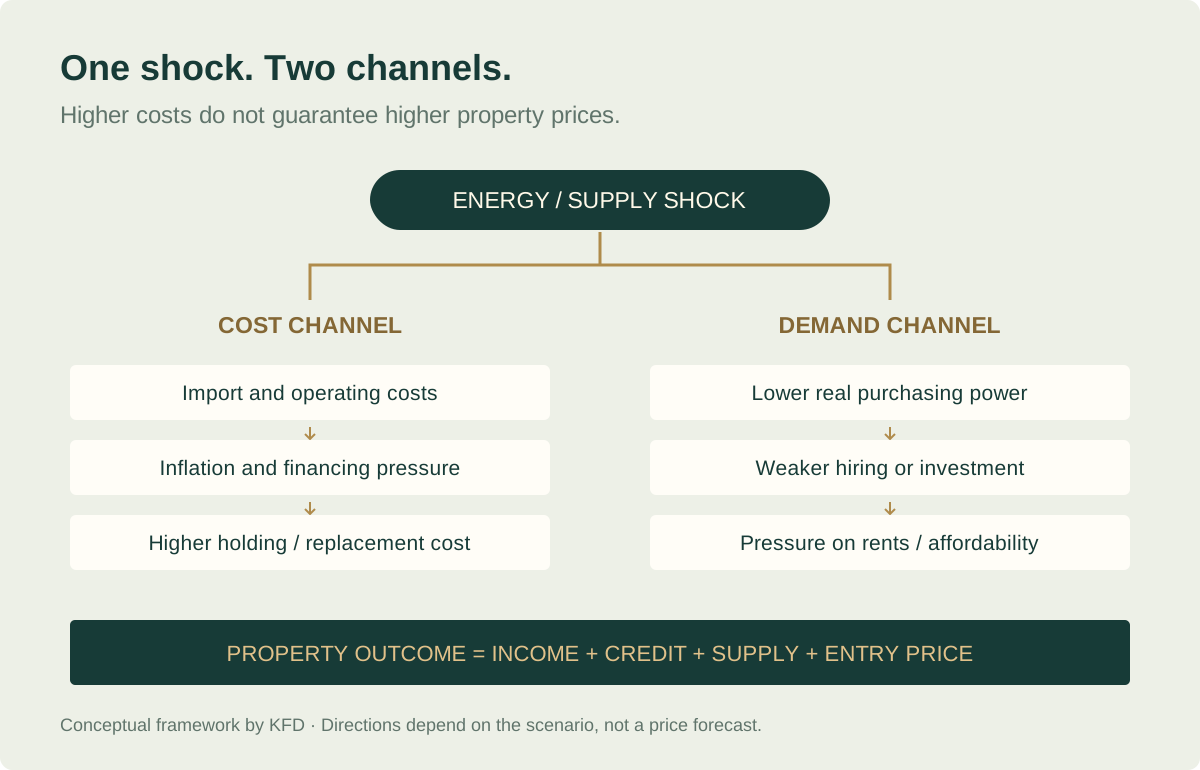
Higher construction costs do not guarantee that buyers will pay higher home prices. Without matching income, rent or credit, cost pressure may instead reduce margins, delay projects or slow transactions.
Singapore’s monetary policy operates primarily through the S$NEER policy band. In October, MAS maintained its appreciation rate, width and centre to address imported inflation. That is not a commitment to a particular mortgage rate.[2]
Distinguish the SORA benchmark, its compounding period and the bank’s spread. Overnight SORA and three-month compounded SORA are different measures; neither alone is a borrower’s mortgage quotation.[6] A repricing stress test is more useful than anchoring on a low benchmark reading.
03AI creates opportunity—and a cycle
AI investment may support demand for equipment, computing capacity and professional services. Several links still need checking before that becomes a reason to pay more for a particular condominium.
| Layer | Question to verify |
|---|---|
| Business investment | Has investment been deployed, rather than merely announced or funded? |
| Jobs and income | Are roles located in Singapore or elsewhere, and what rental budgets do they support? |
| Housing choices | Which projects fit employees’ commuting, family and budget needs? |
| Asset pricing | How much expected growth is already reflected in the asking price? |
MAS’s October outlook recognises technology demand while also identifying a pullback in AI investment as a risk.[2] Long-term technological progress and a shorter valuation correction can coexist.
The Johor–Singapore Special Economic Zone is another development to monitor; its agreement was signed on 6 January 2025.[10] Industrial collaboration still needs to translate into actual jobs and housing choices. Our analytical test is to identify who works where and what they can pay in rent before deciding which property benefits.
04Prime does not mean cheap at any price
Selected new-launch transactions above S$3,000 psf do not establish that the entire RCR has crossed that level. Nor do they establish that an older CCR resale home is automatically undervalued.
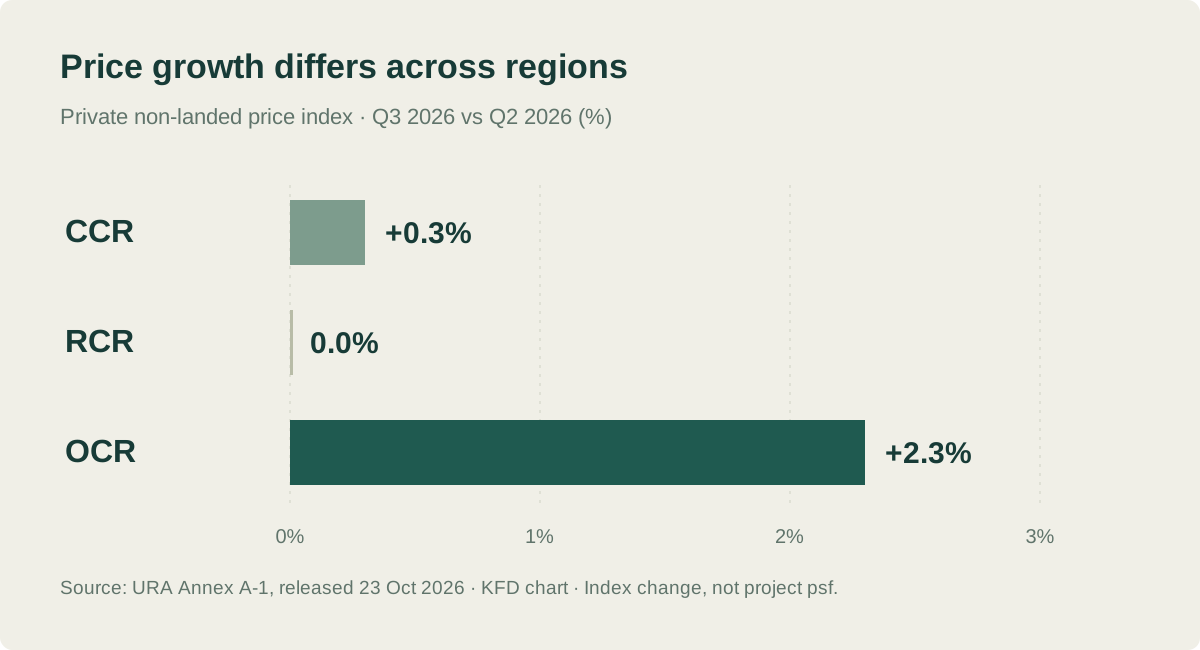
Compare tenure, remaining lease, age, size and total quantum, floor and facing, renovation, leasing evidence and nearby supply. Region labels do not replace an asset-level comparison.
Freehold or 999-year tenure can be scarce without removing maintenance costs, liquidity risk or overpayment risk. Landed property also calls for a building-condition review, planning assessment and realistic works budget.
Eligibility and tax change the investment case
Foreign individuals generally face 60% ABSD on residential purchases; non-housing-development entity purchases generally face 65%, subject to IRAS rules, reliefs and exceptions.[7] Incorporation is not a general shortcut to lower residential purchase tax.
PR status does not confer unrestricted access to landed housing. Foreign persons, including PRs, generally need approval for restricted residential property.[8] Wealth inflows must be assessed through eligibility, tax and actual purchasing decisions.
05Turn inflation protection into a cash-flow test
Rather than asking only whether prices can rise, ask whether you can keep holding if rates rise or a home stays vacant longer.
This is a teaching illustration, not a project forecast or bank quotation: a S$2 million purchase; a S$1 million, 25-year amortising loan; assumed rent of S$6,000 a month collected for 11 months; and S$12,000 of assumed annual operating expenses, including allowances for property tax, management, insurance, repairs and leasing costs.
The pre-financing net operating yield on the purchase price is 2.7%. Acquisition taxes and transaction costs, personal income tax and changes in capital value are excluded. Including acquisition costs in the denominator changes the yield.
| Assumed annual rate | Monthly principal + interest | Annual cash flow after debt service |
|---|---|---|
| 2.0% | S$4,239 | S$3,137 |
| 3.0% | S$4,742 | S$-2,905 |
| 4.0% | S$5,278 | S$-9,340 |
Payments use the assumed fixed annual rate and the standard fully amortising formula. Amounts are rounded to the nearest Singapore dollar; annual cash flow uses unrounded payments. These are not current bank quotes.
Net operating yield, cash flow after debt service and total investment return are different measures. Debt service includes principal repayment. Negative cash flow is not an equal accounting loss, while positive cash flow does not guarantee a profitable exit.
The general TDSR threshold is 55% of monthly income, subject to MAS’s scope and exceptions.[9] A lender’s borrowing limit should not automatically become a household’s spending target.
06Three scenarios, rather than one prediction
| Possible scenario | What to watch | Decision implication |
|---|---|---|
| Energy costs remain elevated | Income, loan repricing and operating costs | Preserve liquidity; do not assume capital appreciation absorbs every cost. |
| Energy pressure eases, employment holds | Achieved rents, financing costs and competing supply | Revisit holding costs without ignoring the entry price. |
| AI spending and hiring slow | Recruitment, rental budgets, vacancy and lease turnover | Test tenant concentration and the ability to re-let. |
None implies that all homes move together. An owner-occupied home and a highly leveraged investment can experience the same shock differently. Holding through a cycle starts with the capacity to do so.
07Three KFD decision principles
- Verify demand before claiming scarcity.
Identify the next tenant and buyer using transactions and comparable alternatives.
- Test holding capacity before discussing return.
Bring rates, vacancy, maintenance and taxes into one cash-flow model, with liquidity appropriate to household income risk.
- Compare entry prices before invoking the long term.
A long horizon can reduce forced-sale risk; it cannot make every premium sensible.
The task is not to turn every headline into a reason to buy. It is to ensure that each purchase still works when the headlines change.
Data-Driven Insights. Smarter Property Decisions. Long-Term Wealth Creation. In practice, that means explaining demand, price, financing and exit options clearly.
08Data and official sources
Official sources checked on 26 October 2026. Forecasts are labelled; calculations and scenarios are KFD illustrations, not official projections.
- Government full-year GDP growth forecast · 11 Aug 2026https://www.meti.gov.sg/newsroom/mti-upgrades-2026-gdp-growth-forecast-to--4-5-to-5-5-per-cent-/
- MAS Monetary Policy Statement · 14 Oct 2026https://www.mas.gov.sg/news/monetary-policy-statements/2026/mas-monetary-policy-statement-14oct26
- URA Q3 2026 real estate statistics · 23 Oct 2026https://www.ura.gov.sg/news/media/pr26-73/
- URA Annex A-1: price indices · Q3 2026https://isomer-user-content.by.gov.sg/467/955c3039-a8e6-45d5-a6d0-95f0b6f58704/pr26-73a1.pdf
- URA Annex E-1: stock, vacancy and pipeline · Q3 2026https://isomer-user-content.by.gov.sg/467/188266a9-76a3-476a-aec4-4b4c8ea2092c/pr26-73e1.pdf
- MAS: SORA interest-rate benchmarkhttps://www.mas.gov.sg/monetary-policy/SORA
- IRAS: Additional Buyer’s Stamp Dutyhttps://www.iras.gov.sg/taxes/stamp-duty/for-property/buying-or-acquiring-property/additional-buyer%27s-stamp-duty-%28absd%29
- SLA: foreign ownership of propertyhttps://www.sla.gov.sg/regulatory/foreign-ownership-of-property/
- MAS: TDSR thresholds for property loanshttps://www.mas.gov.sg/regulation/explainers/tdsr-for-property-loans/calculating-tdsr-thresholds
- EDB: Johor–Singapore Special Economic Zonehttps://www.edb.gov.sg/en/johor-singapore-special-economic-zone.html
Discuss asset strategy with Clarence
Discuss property comparisons, holding costs and the assumptions behind your next property decision with Clarence Foo 符策铭.
Discuss asset strategy with Clarence ↗Continue reading: property upgrading and asset choices ↗
This is general market research, not a recommendation for a particular property or a promise of return. Loan terms, tax and eligibility depend on current rules and individual circumstances. Figures, scenarios and assumptions are separated in the article.